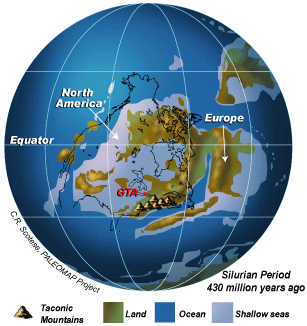
The Earth's crust is made up of pieces called plates. Magma from the Earth's interior rises and slowly pushes the plates apart where, over long periods of time, they eventually collide. These collisions build mountains, cause earthquakes and volcanoes, and bend or buckle the plates. About 450 million years ago, what are now North America and Europe collided near the equator. This collision formed the Taconic Mountains in the northeastern United States and the Michigan Basin - the setting for the Niagara Escarpment.
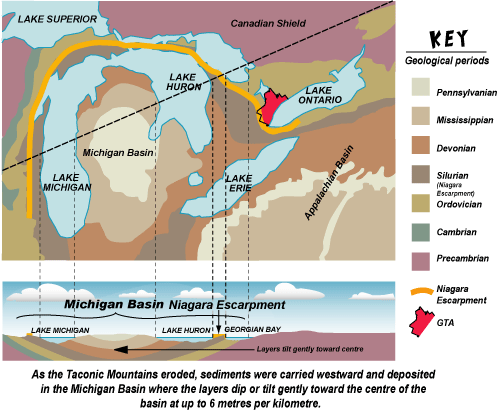
As the Taconic Mountains eroded, sediments were carried westward and deposited in the Michigan Basin where the layers dip or tilt gently toward the centre of the basin at up to 6 metres per kilometre.
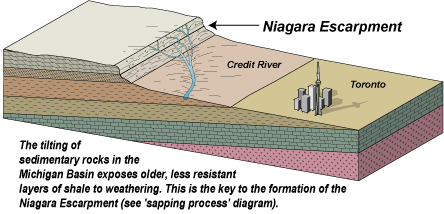
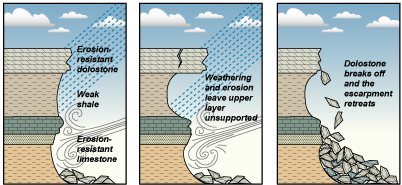
The tilting of sedimentary rocks in the Michigan Basin exposes older, less resistant layers of shale to weathering. This is the key to the formation of the Niagara Escarpment (see 'sapping process' diagram below).
Unburied Treasure!
The escarpment contains wetlands and some of the largest wooded areas in southern Ontario - both of which support rare plants and animals. Crushed rock from the escarpment is used to build roads and houses; blocks of sandstone were used to build Ontario's Parliament buildings.
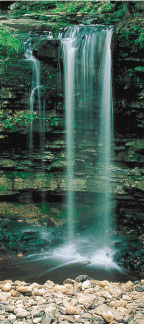
Precipitation trickles down through cracks in the rocks to be stored as groundwater, which supplies drinking water and forms the headwaters of the Credit River and Bronte Creek.
The escarpment provides accessible recreational opportunities including hiking along one of Ontario's oldest and longest trails - The Bruce Trail. In 1985, in response to competing land uses on the escarpment, the government of Ontario enacted the Niagara Escarpment Plan, Canada's first large-scale environmental land-use plan. The escarpment has been named by UNESCO as a World Biosphere Reserve.
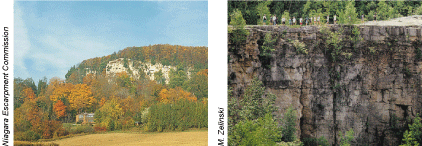
In Ontario, the Niagara Escarpment is a prominent cliff extending for over 500 kilometres from Niagara Falls, through the western part of the GTA and north past Manitoulin Island, following the rim of the Michigan Basin.
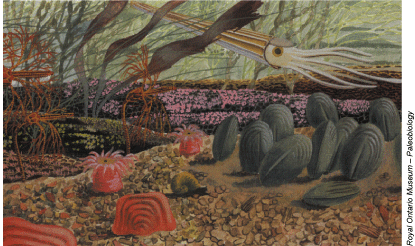
During the Silurian Period, rising seas flooded much of the continent. At that time the GTA was south of the equator and the warm shallow seas were inhabited by an abundance of marine invertebrates as depicted in the reconstruction below. Remains of these organisms are preserved as fossils in the rocks that form the Niagara Escarpment.
Sapping Process
Since the tropical seas disappeared millions of years ago, exposure to the elements has caused weathering and removal of the softer underlying shale, leaving a steep dolostone cap. This weathering process, called sapping, continues today.
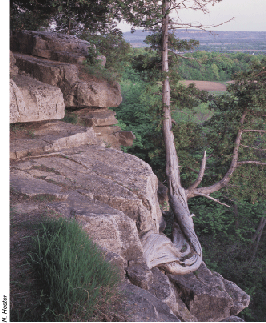
The Niagara Escarpment provides habitat for many unusual species including 1000 year old Eastern white cedars, the oldest living trees in eastern North America.
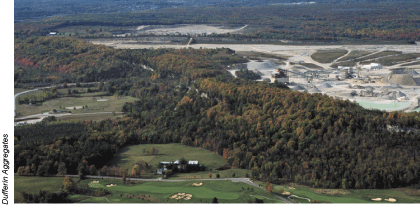
Grey cliffs of the escarpment are exposed within a forested strip. Below the cliffs, a golf course shows one of the recreational uses of this area. Above the cliffs, dolostone is being extracted for construction.